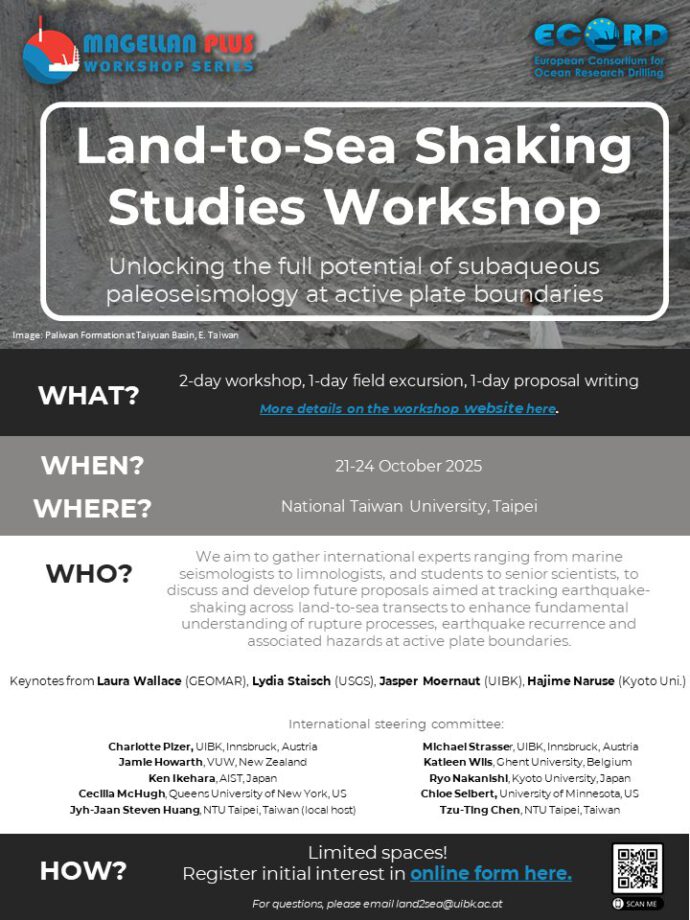
The workshop Land-to-Sea Shaking Studies – Unlocking the full potential of subaqueous paleoseismology at active plate boundaries will be held from 21-24 October, 2025, at National Taiwan University, Taipei. This event is part of the Magellan Plus workshop series and will include keynote talks, orals and posters, breakout discussions, a session on proposal writing, and a field excursion. Check out the website here. You can already register your interestin attending via the online form.
New research challenges the assumption that only strong earthquakes cause liquefaction. Scientists from Poland demonstrated that even low-magnitude shocks (~M3.5) can trigger sediment deformation in water-saturated fine-grained sediments. This finding expands our understanding of seismic activity and its effects on geological structures.
Can we “read” earthquake history by analyzing microscopic quartz grains? New research suggests we can! Scientists from Adam Mickiewicz University in Poznań and the University of Potsdam have introduced an innovative method for studying seismic liquefaction. Their findings, published in the Journal of Structural Geology, reveal that quartz microstructures can help identify past earthquakes.
Jim McCalpin will give a talk on paleoseismology, its history, and its applications in the framework of the GeoLearn Hub and the Geohazards Communities online: Sunday, 16 February, 13:00 GMT.
The 2025 Hokudan meeting on active faulting was held online this year from 23-25 January. It was organised by our friend Koji Okumura. The abstract volume is now available for download here: https://home.hiroshima-u.ac.jp/kojiok/hokudan2025.html. Check it out, there’s some truly cool stuff, for example a trench with a 1700 year-old human skull in it…
River systems are shaped by both gradual and sudden geological processes, and the influence of active tectonics on river behaviour is a fundamental concept in tectonic and fluvial geomorphology. Despite this, much is still unknown about how earthquake surface deformation can alter flood hazard. This is concerning as human populations are increasingly expanding onto floodplains in seismically active regions. A recent review by McEwan et al (2025) in Earth-Science Reviews addresses this knowledge gap by analysing data from 52 sites where fault deformation is known to have induced an immediate change in river behavior; otherwise referred to as a Coseismic River Response (CRR).
Jacek Szczygieł is looking for a Postdoc (2 years) for his project “Enhancing Paleoseismological Records through Multi-Methods Cave Deformation Analysis Tested in Diverse Hellenides Tectonic Regimes.”
The postdoc will be responsible for coordinating and obtaining input data for the FEM analysis and performing FEM modeling of speleothems.
More information below, or follow this link. Application deadline is the 14th of January
In this month’s paper list there are a lot of studies on the US, Greece, and New Zealand, plus interesting stuff from Russia and China and on tsunamis. But don’t miss the methodological papers, for example on underwater photogrammetry. Happy reading!