Christoph Grützner

Christoph Grützner

works at the Institute of Geological Sciences, Jena University. He likes Central Asia and the Mediterranean and looks for ancient earthquakes.

  • Call for papers on the Venezuela and Colombia Earthquakes

    SSA’s journal Seismological Research Letters has issued a call for papers for a focus section on the destructive 2026 Venezuela and Colombia Earthquakes. Deadline for submissions is 21 December, 2026. Guest editors: Franck Audemard, Benazir Orihuela, Omar J. Pérez, Jorge G. F. Crempien, Carlos E. Reinoza Gómez, and Manuel Alberto Florez. 

    On 24 June, two shallow earthquakes with magnitudes of MW7.2 and MW7.5, respectively, ruptured the coast of northern Venezuela in close succession, leaving thousands of people dead. On 10 August, an MW7.5 event in ~100 km depth shook western Colombia, leading to hundreds of fatalities and the destruction of thousands of buildings.

  • Call for application to the IDASH Training Programme – Seismic Hazard Assessment in CEI Regions

    Applications are invited for the IDASH Training Programme (Integration of Data and Approaches for Seismic Hazard Assessment in CEI Regions).

    The programme offers a series of online lectures delivered by international experts, focusing on methods, data, and applications for seismic hazard assessment in the CEI (Central European Initiative) region and beyond.

    Full information, lecture schedule, speakers, and the application form are available on the project website:

    Project website: https://progetti.ingv.it/en/idash

    Training Programme and Application Form:
    https://progetti.ingv.it/en/idash/activities/training-program/idash-training-programme

    Application deadline: 16 August 2026.

    Applications are open to postgraduate, Master’s, and PhD students, early-career scientists, and senior experts from all CEI countries, both EU and non-EU members.

    Priority for workshop participation and limited financial support or grants will be given to applicants from EU candidate countries within the CEI region, namely Albania, Bosnia and Herzegovina, Moldova, Montenegro, North Macedonia, Serbia, and Ukraine.

    Application for the online lectures (only) is open to anyone interested in attending the sessions, regardless of whether they are based in CEI member states or in countries outside the CEI region.


  • New papers on paleoseismology, active tectonics, and archaeoseismology (Aug 2026)

    This time we have, among others, some nice papers on recent and not-so-recent seismites, very interesting methodological studies on paleoseismology and tectonic geomorphology, some cool coastal/offshore paleoseismology, and a few articles on earthquake geology from a hazard perspective. Enjoy reading!


    more
  • New Paper: A History of Earthquakes Hidden Beneath the Great Salt Lake (Utah, USA)

    Guest blog by Christopher B. DuRoss from the U.S. Geological Survey (USGS).

    The Great Salt Lake is the largest low-relief, terminal basin in the western United States. In a collaborative effort led by earthquake geologists from the U.S. Geological Survey (USGS) Geologic Hazards Science Center (Golden, Colorado) and marine geophysicists from the USGS Pacific Coastal and Marine Science Center (Santa Cruz, California), we set out to explore whether this shallow, biogenic carbonate basin holds acoustic and sedimentary archives of past earthquake ruptures (DuRoss et al., 2026).

    more
  • New papers on paleoseismology, active tectonics, and archaeoseismology (July 2026)

    For some reason–and it may very well just be my personal bias–today’s list has a lot of studies on active tectonics of the Americas and Central Asia. But then the western US and the Andes plus Central Asia make up a good portion of the total seismic moment release apart from subduction quakes, so perhaps this is not unusual. At some point I’d like to make a world map showing seismic moment release vs. number and distribution of scientific studies…
    Enjoy reading and please let me know if I’ve missed something.

    more
  • New papers on paleoseismology, active tectonics, and archaeoseismology (June 2026)

    This month we have many case studies from all around the world, including classical paleoseismology, historical data, and tectonic geomorphology. But there are also studies more leaning towards the methodological side of our discipline, and who would have thought that an entire new type of fault systems was just discovered? Enjoy reading!

    more
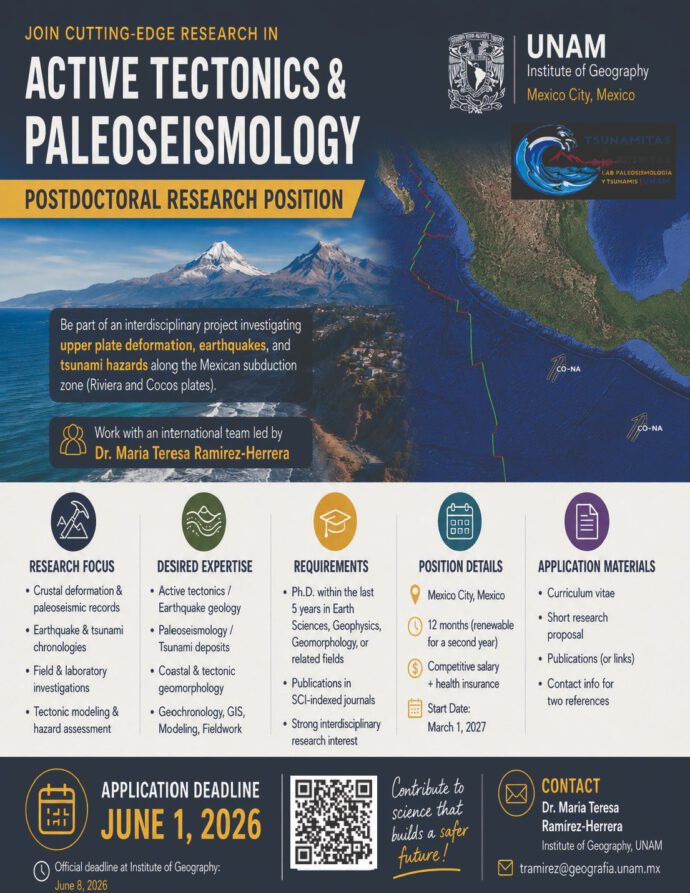
  • Posdoctoral Research Position in Active Tectonics and Paleoseismology at UNAM, Mexico

    Maria Teresa Ramírez-Herrera is seeking to fill a postdoc position in her group at UNAM, Mexico. Application deadline is 1 June, 2026:

  • Abstract Volume of the 2026 PATA Days in Guatemala now available

    The conference proceedings of the 13th International INQUA meeting on Paleoseismology, Active Tectonics and Archaeoseismology – PATA Days 2026 are now published and available for download: https://doi.org/10.5281/zenodo.20043287.  The volume contains all submitted and reviewed extended and short abstracts on 135 pages. The meeting was held in Antigua Guatemala from 30 Jan – 05 Feb, 2026. 

    Cite the volume as:

    Gordillo, C, Flores, O., Grützner, C., Niemi, T. M., & Obrist-Farner, J. (2026). Proceedings of the 13th International INQUA meeting on Paleoseismology, Active Tectonics and Archaeoseismology – PATA Days 2026. 30 Jan – 05 Feb, 2026, Antigua Guatemala, Guatemala. https://doi.org/10.5281/zenodod.20043287.

    You can find the field trip guides (and also the abstract volume) for download here: http://pata-days.org/downloads/ – as well as those of all previous PATA meetings. Enjoy reading!


  • New papers on paleoseismology, active tectonics, and archaeoseismology (May 2026)

    Here is the latest paper list with a nice variety of topics and also geographically quite divers I think. Enjoy reading, and let me know if I have missed a paper.

    more
  • 7th Fault2SHA Workshop – Additional spaces available

    The 7th Fault2SHA Workshop – New Frontiers in Earthquake Rupture Forecasting and Probabilistic Seismic Hazard Assessment will take place in Vienna, Austria, from 6–8 July 2026. A few additional places have become available. If you would like to participate or know someone who will, please complete or share the registration form. The registration fee is €300. A reduced fee of €150 is available for PhD students and early postdoctoral researchers (i.e., those who obtained their PhD after 1 January 2024). Deadline for registration and payment is 30 April 2026. Places will be allocated on a first-come, first-served basis.

    For news and updates about the workshop and related activities, visit: https://fault2sha.net/7th-workshop/


    more