Today’s list of papers includes a large number of publications on the Tibetan Plateau, but earthquake aficionados will also find interesting studies on methodological aspects of earthquake geology and case studies from Europa, the Americas, and Aotearoa / New Zealand. Enjoy reading and let us know if we’ve missed something!
Most studies in this month’s list deal with the active tectonics of Asia and the Mediterranean, but we have a wide variety of different methods covered. Make sure to check out the latest applications of the ESI2007 scale. There are also very interesting papers on fault interaction and fault behaviour in general, about cascading hazards, and about quakes in lakes. And of course there is the really cool “InSAR lookbook”. Enjoy reading!
All eyes are on the horrible consequences of the Myanmar Earthquake right now. Let’s hope that on the long term, this event helps us to be better prepared for large earthquakes elsewhere. Meanwhile, lots of interesting papers have been published, among them many that deal with seismic hazard and cascading effects and actually also one on Myanmar (Sethanant et al., 2025). Let us know in the comments of there’s something missing.
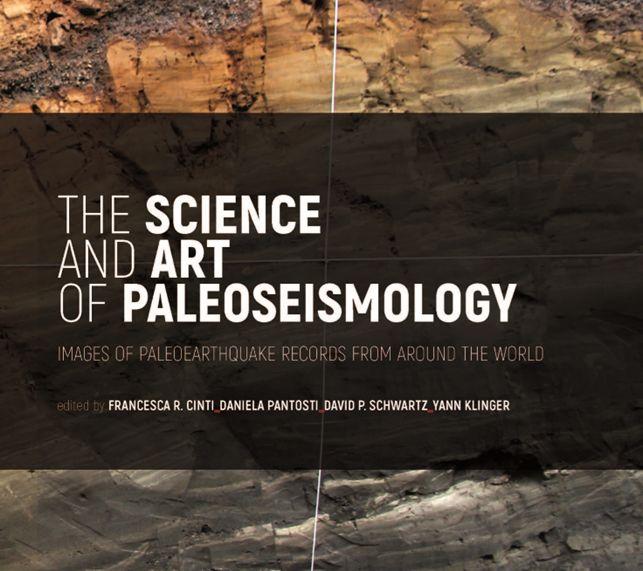
The Science and Art of Paleoseismology Images of Paleoearthquake Records From Around The World Edited by Francesca R. Cinti, Daniela Pantosti, David P. Schwartz, Yann Klinger Printed in 2025
Our primary objective in publishing the book “The Science and Art of Paleoseismology” is to present observations through images of individual earthquake surface ruptures exposed in trenches across active faults in shallow continental crust across the globe.
With this book we aim to provide young researchers, students, and working professionals undertaking paleoseismologic studies with images of the variable expression of surface fault ruptures in trench exposures and their interpretations. The book contains examples from strike-slip, reverse, and normal fault ruptures in a range of tectonic settings as well as descriptions of the criteria and tools used for rupture identification, thereby strengthening the interpretation of surface-fault rupture histories and earthquake recurrence.
The book includes 28 case studies by a large number of contributors. 13 are on strike-slip, 6 on reverse, and 9 on normal faults. Each rupture example is developed in four pages of photos, trench logs, maps, and text.
If you are interested in obtaining a copy of the book you can get it for free but you need to cover the shipping fees. Please send a request to the email address below including the number of copies you are willing to receive and your complete postal address. We will provide you with instructions (size, weight, address, etc.) for preparing the pre-paid shipping label. scienceandartpaleoseismology@gmail.com
A digital copy of the book is planned at a later date. Looking forward to getting your feedback
This week’s list of papers has some interesting work on soft-sediment deformation and quite a number of studies from the Mediterranean region. But you’ll also find something interesting if you’re more into earthquakes in the Americas, South Korea and Central and Eastern Asia. Enjoy reading!
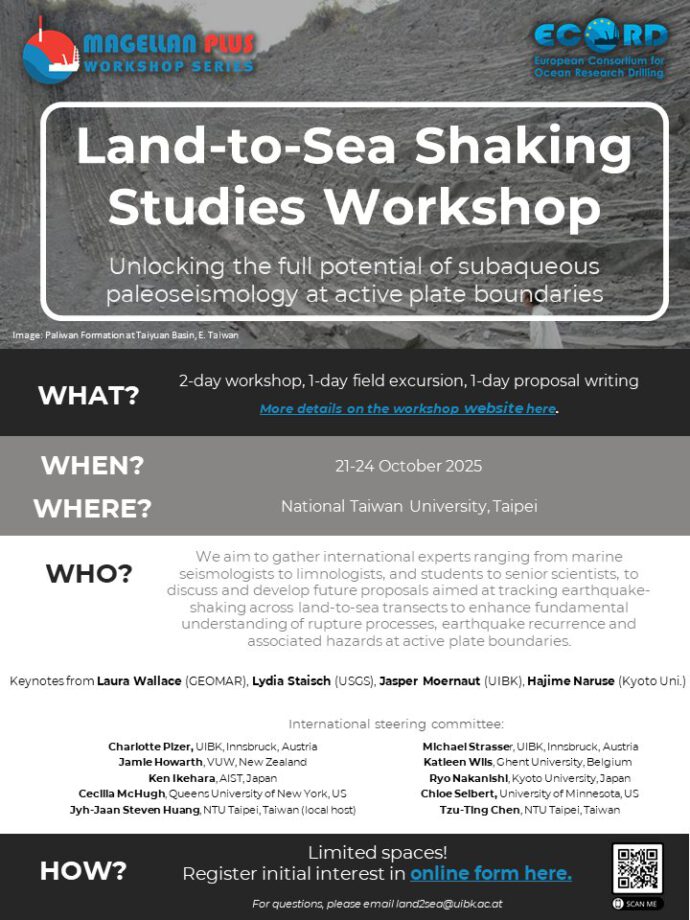
The workshop Land-to-Sea Shaking Studies – Unlocking the full potential of subaqueous paleoseismology at active plate boundaries will be held from 21-24 October, 2025, at National Taiwan University, Taipei. This event is part of the Magellan Plus workshop series and will include keynote talks, orals and posters, breakout discussions, a session on proposal writing, and a field excursion. Check out the website here. You can already register your interestin attending via the online form.
We are aiming to organize a special issue titled: Intraplate Tectonics: Earthquakes, active tectonics, and seismic hazard in regions of slow lithospheric deformation. This special issue will complement a number of recent conference sessions on Intraplate Tectonics and Seismicity that have been held at EGU, IGC, INQUA and other societies over the past number of years. The solicitation for contributions to the special issue is below. If you or your colleagues are interested in submitting an article to the special issue, please let us know a tentative title and your list of authors with affiliations by the end of April; send it directly to k.reicherter@nug.rwth-aachen.de. Anticipated deadline for submission of manuscripts 31.12.2025.
Sincerely,
The special issue guest editors: Klaus Reicherter, Beau Whitney, Tamarah King, Sambit Naik
It took a while, but now it’s finally here: Understanding Past Earthquakes, an open access book on the science of identifying large earthquakes. It deals with fundamental questions on large past events: Where did earthquakes occur? How large were they? Which tectonic faults caused them? How strong were the ground motions and where? Six chapters cover the following subjects:
Ou et al. – Earthquake Source Parameters Determination Using Analog Seismic Records
Hough – Macroseismology
Sintubin – Archaeoseismology: Identifying Earthquake Effects in Ancient Sites
Zielke & Klinger – Past Earthquakes in Continental Settings—A Geomorphologic Perspective
Philibosian – Paleoseismology and Paleogeodesy Using Coral Microatolls
Moernaut et al. – Lacustrine Records of Past Seismic Shaking