
2016-02-07 | in Centerfault, Paper | one response
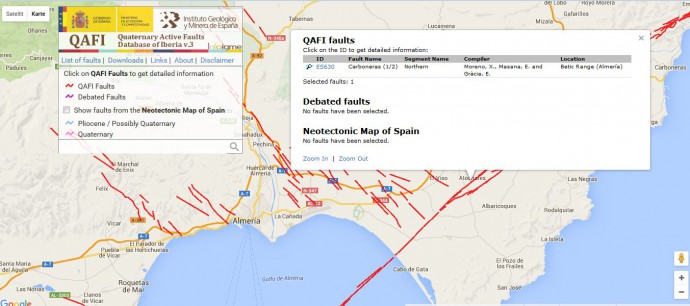
Great news reached us from Spain! Our colleague Julián Garcia Mayordomo spread the news that an updated version of the Quaternary Active Faults Database of Iberia (QAFI) is now available online. QAFI has a GoogleMaps-based interface with clickable features providing loads of content on fault geometry, fault mechanism, slip-rate, historical and pre-historical seismicity, geomorphology, compilers, further references and much more. Truly a wonderful tool, congratulations!
QAFI is hosted by IGME and can be found here: http://info.igme.es/qafi/
Make sure to read the user’s guide and the background information.
References
- J. García-Mayordomo, J.M. Insua-Arévalo, J.J. Martínez-Díaz, A. Jiménez-Díaz, R. Martín-Banda, S. Martín-Alfageme, J.A. Álvarez-Gómez, M. Rodríguez-Peces, R. Pérez-López, M.A. Rodríguez-Pascua, E. Masana, H. Perea, F. Martín-González, J. Giner-Robles, E.S. Nemser, J. Cabral and the QAFI Compilers Working Group (2012) The Quaternary Active Faults Database of Iberia (QAFI v.2.0), Journal of Iberian Geology, 38(1): 285-302.
-
IGME (2015). QAFI v.3: Quaternary Active Faults Database of Iberia. Accessed “DATE”, from IGME web site: http://info.igme.es/QAFI




School of Computing | 2026-06-24|13:04 (UTC)
Databases like QAFI are essential for understanding seismic hazards, but they are never fully complete. How should engineers and policymakers account for scientific uncertainty when using evolving fault databases to guide long-term infrastructure planning and earthquake risk assessments?
bif